
I've written about cohesion before in this article where I shared my view that cohesion isn't a skill to be caught but something that can actively be taught. In that article I share the elements of cohesion that are explicitly mentioned in the English national curriculum:
Pronouns and nouns used within and across sentences
Adverbials used within and across paragraphs
Tense choices such as the use of progressive forms
Choosing to use repetition
Ellipses of words
Along with aspects of cohesion that are implicitly included in the national curriculum such as the use of conjunctions, adverbials and prepositions. I then set this out visually with our cohesion road map.
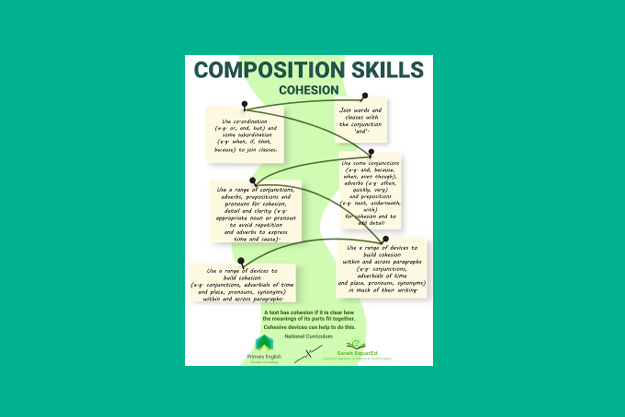
Our Cohesion roadmap in png format. Use it in your documents and for classroom displays. A great way to ensure there is progression and a clear route way through cohesion in your school.
Made with our partners SarahSquarED.
This is a great start, but there is more we can do to make sure children's writing sounds right. Here are just a few to get started with.
Conjunctions
There are plenty of classroom resources such as FANBOYS that prompt children to recall some of the conjunctions available to them. However, some children continue to choose conjunctions that don't quite suit their writing meaning it doesn't sound right. Teaching the meaning of each conjunction and the effect it has on meaning in a sentence is an essential part of improving children’s conjunction usage. Visual aids such as our Because, But, So Poster are great for this. We borrowed the idea from The Writing Revolution (which incidentally has some wonderful oracy activities to support conjunction usage). We adapted it by adding symbols that provide extra support to understand what each chosen conjunction means and does.

Enhance your classroom environment with our attractive poster covering the conjunctions: because, so, but. Our poster is designed to engage young learners, helping them to understand how these key conjunctions link ideas in sentences. The poster supports a clearer understanding of sentence structure, encouraging confident, cohesive and creative writing.
This poster is inspired by The Writing Revolution by Hochman and Wexler.
Adjective order
The red big car drove quickly.
An English scary monster ran through the woods.
If you've taught younger writers, you'll be familiar with these types of sentences where they’ve constructed expanded noun phrases that simply don't sound right, and when writing doesn't sound right, it lacks cohesion. Fixing this sense of what sounds right is tricky which is why we created our Adjective Order Poster so you can easily illustrate the adjective order that sounds right.
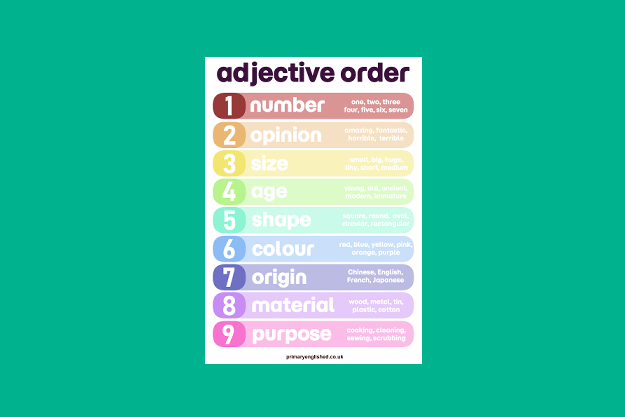
Do your children write expanded noun phrases that just sound a bit ‘off’? We’ve created this handy poster to help them order their adjectives so that they sound just right!
Free to download, this printable poster will make a quick and easy improvement to your children’s writing. What’s not to like!
I or me?
To the trained ear, the correct (or incorrect) use of I or me can alter the sound of writing and so impact upon cohesion. In this article, I start by posing the question which of the following sentences is correct?
The bus waited for Sam and me.
The bus waited for Sam and I.
The answer is not always what the reader expects, which shows how this small grammatical point can influence whether a piece of writing sounds right. Our I or Me Skill Set is written to help you teach this tricky rule that helps writing sound right.

Help children identify when to use I or me when there is more than one person in a sentence with this Skills Set pack.
The ready-to-use resources in this pack can be used for stand alone work, as part of your teaching sequences, to supplement our Starting Points resources, and for revision.
We’ve included a teaching powerpoint, teacher support notes and resources to support learning so that both you and your children have the key information you need to secure this frequently confused aspect of English grammar.
In this Skill Set you will find:
Teacher notes
Presentation in PDF and PPT formats
Pronouns sorting cards
Subject, verb, object activity sheets
I or Me activity sheet.
This pack is suitable for use across key stage 2.
These suggestions are just a start. It’s highly likely that over time I’ll add to this article with other aspects of cohesion that can be taught and not just caught. Watch this space to see what I come up with!